Thursday, February 7, 2013

A Valentine to Oaxaca

August, 2012. We are in the City of Oaxaca, in southern Mexico, searching out fine artisan crafts for Chiripa.

Oaxaca rooftops

We love to walk the streets of Oaxaca, one of our favorite cities in all of Mexico. 
Oaxaca is sophisticated, but down to earth, and inhabited by charming people. 

A Day on the church steps, Oaxaca

We love the morning mist on the mountains, the afternoon sun and shadow, the cool evenings, the friendly light of the food seller's stall after dark.

Food vendor and customers, Oaxaca

We love the green cut stone of the buildings, the echoing church bells, the museums, the old monasteries, the elegant courtyards, and the daily grit and clamor of the market.  

Textile Museum, Oaxaca

We love the cobblestone streets and sidewalks, the street vendors, the students, the shopkeepers, the balloon sellers and the roaming mariachi bands. We love the giant papier mache puppets and the families strolling together. 

Oaxaca Street

We love the smells of coffee, chocolate, peppers, fresh vegetables, fried tortillas and roasting corn. We love the crowded sidewalks in the market district.  We love the flat nasal shouts of the bus conductors, calling out destinations. We even love the belching, rumbling, swaying, rundown buses that are often named (like fishing boats) after saints or loved ones.  

Market stall, Oaxaca

Everywhere in Oaxaca, proud and graceful people are working hard to make a living. People are building, hauling, cooking, counting, sweeping, selling, and playing music in the streets.

Street musician and green stone.
Oaxaca

Thank you, Oaxaca. - JM


Santo Domingo at Night


Tuesday, January 29, 2013

Nicodemus

August, 2012.  We are in the city of Oaxaca, in southern Mexico, searching out fine artisan crafts for Chiripa.


At the corner of Mina and J.P. García, in the market district southwest of the central plaza, there is a little shop that sells tin and other artisan crafts. Nicodemus, a gentleman of 81 years, has operated the shop for over half a century. For most of those years, he worked 6 days a week (he closed the shop on Sundays to spend time with his wife and family). But since his wife died 9 years ago, he now spends every day in the shop. He feels at home there.

Nicodemus is a retailer, not a maker of crafts. But he is an artist in his own way. He knows what it means to run a shop in good times and bad. Untold thousands of craft pieces have passed through his hands, and he knows exactly what size box he will need for the many pieces we buy. He stores his boxes near the ceiling, and pulls them down with a long wooden pole. He wraps the craft items expertly, and fits them precisely into the box he has selected. The box is exactly full.


Nicodemus and Chiripa friend


Nicodemus is charming and courteous, and not at all pushy. He moves gracefully around his little domain, despite his 81 years. He knows where everything is, and he wastes no motion. He loves to talk about his business, including the good old days when he was selling “tons” of crafts to Japanese buyers who trusted him to arrange complex orders. To every purchaser he gives little handout sheets describing interesting details of Oaxacan history and culture.

Nicodemus had little formal education, but by hard work managed to send all his children to school. His children now have good jobs, and Nicodemus lives with his son. On one wall of the shop there is a large poster, marking the 50th anniversary of the business. The poster features a picture of Nicodemus, and is inscribed to Don Nicodemus (a title indicating great respect) by his loving children. 

Although Nicodemus has operated his shop for over a half century, he does not actually own the building in which it is housed. On the day we were there, the landlord called about the rent payment. Nicodemus told him that the rent was on its way. - JM


Friday, January 11, 2013

Change Comes to San Cristóbol

August, 2012.  We are traveling in southern Mexico, searching out unique and beautiful local crafts for Chiripa.

San Cristóbol de las Casas is an old colonial city in the Chiapas highlands. In this place, the past is everywhere. Our hotel, for example, was once the home of Diego de Mazariegos, who led the Spanish invasion of Chiapas in 1528.  But the local indigenous culture is far, far older than that.

Old Church Door
San Cristóbol de las Casas

The industrial city of Tuxtla Gutierrez is just an hour or two away, by bus. But it is much harder to get to San Cristóbol from other metropolitan areas, as we rediscovered on our 11-hour bus ride from Oaxaca. New federal highway projects may reduce the city’s isolation, for good or ill. But for now, San Cristóbol is still somewhat off the beaten path. 

Off the Beaten Path:
Sleeping Dogs in San Cristóbol

In San Cristóbol, you are just about as likely to hear people speaking a Mayan language as Spanish. And while most Mexicans (like all of us) now wear clothing that has been mass-produced in Asia, many Mayan people here still wear traditional dress that has not changed for centuries. The indigenous people make the clothing with their own hands, using local materials (although we were told that cheap "knock-offs" are now entering the commercial market). 

Fine Traditional Embroidery

For the indigenous people, clothing is an expression of community rather than individuality. Mayan women from the same village wear the same style of dress, much the way members of an athletic team wear the same uniform, except that these traditional "uniforms" are not made by Nike. They bear no corporate logos, and they do not change with the latest fashion trends.


The Changing Streets of San Cristóbal

We first visited San Cristóbal in 1987, and were last there in 1999 (just a few years after the Zapatista uprising). Much has changed since then. The place looks more prosperous. There has been a lot of new investment. There are more cars. There are walking malls lined with pizza and other fast-food restaurants. There are trendy coffee shops and bars. There are retail shops selling expensive things for tourists. There are people staring at smart phones, and waving their fingers over them. 

The current atmosphere resembles, in some ways, a fashionable ski resort. To us, this is a little unsettling. But much of the old San Cristóbal remains.

Colonial Church on a Rainy Afternoon

There are the beautiful old colonial buildings. There is the clean and bracing morning air, and the special light. There are colorful markets, selling local products and crafts. Above all, there are the indigenous people who make San Cristóbol a truly memorable place.

San Cristóbol Street Scene

We spent a lot of time in the local markets. We found amber jewelry created by craftsmen in the village of Simojovel, in a remote area north of San Cristóbol. We found woven and embroidered table linens, purses and more. We had fun talking to vendors who were selling crafts from their home villages. When we climbed back on the bus, for the return 11-hour night ride to Oaxaca, we were packing lots of beautiful crafts and memories.  - JM 


Old and New

Friday, December 21, 2012

The Shaman’s Realm

August 2012 - We are traveling in Chiapas, in southern Mexico, searching for fine artisan crafts for Chiripa.  

The global economy is gradually seeping into the remote corners of Mexico, including Chiapas. But much of Chiapas is still a place apart -- a place of mystery and tradition -- a place that speaks of another time and a very different way of life. 


Village Cemetery, San Juan 
de Chamula, Chiapas


In much of Chiapas, corn is planted by hand on impossibly steep hillsides. Women and children collect large bundles of firewood from the forest, and carry the bundles for long distances on their backs. Corn is ground by hand, and mixed with lime to produce tortilla dough.

In a rural kitchen, a woman kneels on a dirt floor and tends an open wood fire. The fire heats a comal on which a woman fries the tortillas that she has formed and pressed. The dark room fills with smoke and the smell of warm tortillas as the rain falls outside. 

Making Tortillas, Chiapas

In Chiapas, things are not always what they seem. As we enter the quaint village church in San Juan de Chamula, we immediately find ourselves in a very unexpected world. No photographs are allowed within this space. The interior is dark and mysterious, and hundreds of candles flicker everywhere. 

Village Church, San Juan de Chamula

From out of the darkness we hear low repetitive chants -- not the usual chants that one might expect in a Catholic church, but deep-throated chants that remind us of Tibet or Mongolia. And then, unexpectedly, we hear the distressed screech of a chicken. 


Church Entrance, San Juan de Chamula


As our eyes adjust, we see tables covered with beautiful flowers (from the neighboring village of Zinacatlán, which gets charcoal from Chamula in return). The floor is covered with pine needles. Candles burn everywhere on tables and floor. As they burn down, and the wax runs across the floor, some of the pine needles begin to smolder. No one seems concerned.

Village Church, Zinacatlán

We gradually perceive family groups huddled on the floor (there are no church pews). Each group sits in front of a small makeshift altar of candles, flowers and Coca Cola bottles. Penitents drink Coca Cola to make them burp, because the burping is thought to expel evil spirits (a cynical local acquaintance once told us that the Coca Cola distributor had one of the largest houses in the village).

A shaman holds the wrists of a young girl, trying from her pulse to ascertain the source of her malady. Parents and family members kneel nearby, praying for a cure. A doomed chicken, soon to be sacrificed, is held firmly by its legs and neck. The sacrificial and curative rights will cost family members a large share of their weekly income.

Centuries-old statues of Catholic saints line the church walls, but traditional Catholic doctrine holds little sway here. Catholic priests no longer preside in this sanctuary, and from the village of Chamula many evangelical christians have been expelled. For this is the realm of the shaman, and he rules with a strong hand. -- JM


Monday, December 17, 2012

Night Bus to Chiapas

August, 2012.  We continued our journey through southern Mexico, seeking out fine artisan crafts for Chiripa.

From the City of Oaxaca, we took the regular overnight bus to San Cristóbol de Las Casas, in the green highlands of Chiapas. Chiapas is located in the far south of Mexico, next to Guatemala. It is the ancestral homeland of the Mayan people. Our overnight bus trip from Oaxaca to San Cristóbol took more than 11 hours. The route climbed over rugged mountains, descended into hot lowlands in the Isthmus of Tehuántepec, and then climbed again into misty Chiapas. We didn’t get much sleep during the ride, but in Chiapas we met some wonderful people and found some great crafts for Chiripa!


Chiapas Woman with her Folk Art, 
Traditional Blouse and Heavy
Black Woolen Skirt

We started our journey at nightfall, in a pouring rain, and soon left the City of Oaxaca behind us. The bus wound its way up the steep mountain road in complete darkness. Rock walls, brush, guard rails and black empty space swept to and fro across the headlights as the driver negotiated endless switchbacks – now shifting into low gear, now pumping the brakes.  

Occasionally, a heavily loaded truck emerged from the darkness above and roared past us on the narrow road. Other times, we passed sluggish trucks that were grinding up the mountain ahead of us. The windshield wipers kept up a quiet rhythm, and the bus driver played low salsa music to keep himself awake. 


Morning in San Cristóbol, Chiapas

We dozed fitfully in the dark bus, trying in vain to find restful sleeping positions. In the seats ahead and behind, fellow passengers snored (and maybe we did too – at least in our intermittent moments of sleep). As the bus pushed on through the hot Isthmus of Tehuántepec, we passed humble outdoor cafes (comedors) where clusters of people sat eating and conversing in the cool midnight hours. The dimly lighted scenes came and went, as if in a dream. Then our heads dropped and our eyes closed again.


Lunch on the Street, San Cristóbol

Dawn was breaking when we pulled into San Cristóbol. The mountain air was cool and fresh as we stepped down from the bus. Our backs were stiff and our knees were cramped, but a good cup of hot black Chiapas coffee would soon put us in shape for the craft hunt.        - JM

Woman with Braids, San Cristóbol

Sunday, December 9, 2012

True Collectors' Items

August, 2012. We are traveling in the state of Oaxaca, in southern Mexico, in search of fine artisan crafts for Chiripa.

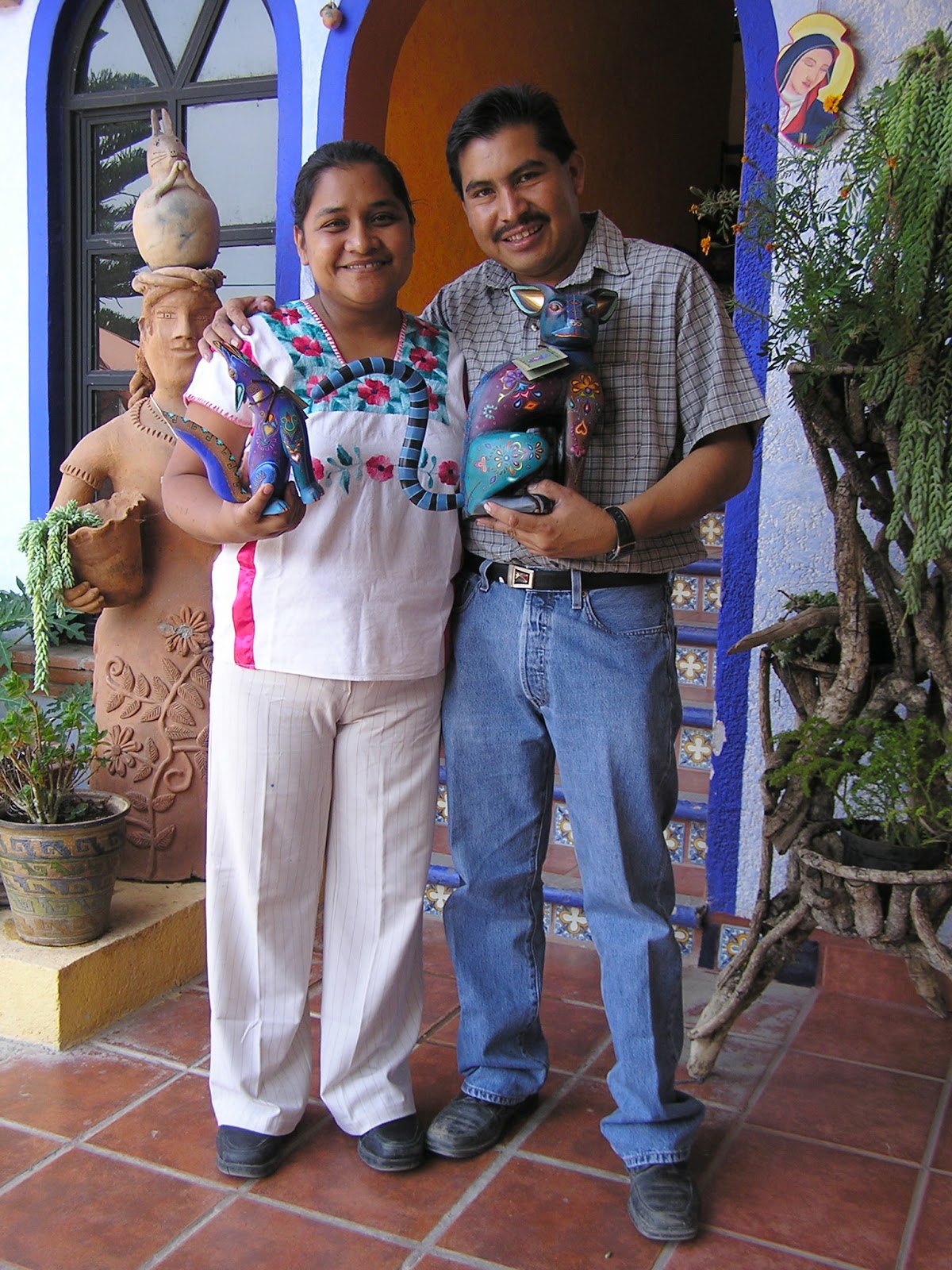
In the world of Mexican indigenous crafts, Jacobo and María Angeles are rock stars. In their colorful workshop, on a dirt-and-cobble lane in the far corner of the small Zapotec village of San Martín Tilcajete, they carve and paint the most beautiful alebrijes on the planet. Jacobo and María were born in the village, and have known each other since they were children. Jacobo learned wood carving from his father, who died when Jacobo was just 12 years old.


Jacobo and Maria Angeles

In the hands of Jacobo and Maria (and their small group of artists), alebrijes are not just carved and painted wooden animals. They are not just common craft objects, or figures slavishly copied from nature. The figures live in a spirit world, at once whimsical and real. They seem to have their own hidden thoughts. They have a timeless quality, at once ancient and stunningly modern. They are elegant and mysterious, and they draw you in. 
Dog alebrije

Skilled hands carve the figures from copal wood. The figures are then carefully dried, and painted with colors made from natural local materials. The artists use fine-tipped brushes to execute minutely detailed, traditional Zapotec patterns. Everything is done with painstaking care and patience, under the exacting eyes of Jacobo and Maria. A single piece takes months to create (one specially-commissioned 4-ft. coyote took over two years!). These works of art come in a variety of sizes, and are sought by knowledgeable collectors throughout the world. 

Carver at Work

During our recent visit, María Angeles told us that they can easily sell every piece they make, and that they are having trouble keeping up with a worldwide demand. We were nevertheless able to obtain some brilliant pieces for Chiripa, because we have known Jacobo and Maria for years. Come to Chiripa and see these collectors’ items for yourself!       - JM

Painter with Skunk Alebrije


Monday, November 26, 2012

Breakfast With a Master Weaver

August. 2012.  We are traveling in the state of Oaxaca, in southern Mexico, seeking out fine artisan crafts for Chiripa.

Bulmaro Perez is one of the finest rug weavers in Mexico. He was born and lives in the Zapotec village of Teotitlán del Valle, in the Central Valley of Oaxaca. This is Mexico’s weaving epicenter, and Bulmaro is among the “best of the best.”  Bulmaro is regularly invited to display his work in U.S. museums and galleries. Bulmaro learned the craft from his father, a nationally recognized maestro, and has taken his father’s craft to a new level. 

Bulmaro and His Father

Bulmaro is steeped in the Zapotec weaving tradition, but often puts a new twist on traditional Zapotec designs. His rugs are made of pure wool, and he uses dyes made from natural local materials like cochineal, witch hazel, indigo, marigolds and pomegranate shells.  Cochineal, used to make the color red, is made from an insect that grows on nopal cactus. In colonial times, it was one of Mexico's most important export products (next to gold and silver) because it was so highly valued in Europe. We have watched Bulmaro dye the wool that he uses.

Natural Dye Materials

Bulmaro is a family man and community leader. Like every other adult male in Teotitlán, he devotes a substantial amount of time each year to village administration and service. He is also a very gentle and hospitable man. His home is filled with flowers, including some unusual varieties that he has collected. 

Bulmaro speaks to his wife in soft Zapotec tones. He pads around on bare feet as he shows his woven creations. His eyes dance with delight at the beauty around him. He smiles easily, nods and tilts his head in courtesy. 

Before showing us his rugs, Bulmaro insisted on buying us breakfast at his favorite taco restaurant. The restaurant specializes in tacos made from beef cheeks. We had to quit after three tacos. He ate five, and with gusto, because he didn’t know when he would get lunch. After breakfast we went to Bulmaro’s house, where we selected some beautiful rugs (including lovely Tree of Life and Zapotec Patio patterns). See them for yourself at Chiripa! - JM


Tree of Life