Showing posts with label Alebrijes. Show all posts

Sunday, December 9, 2012

True Collectors' Items

August, 2012. We are traveling in the state of Oaxaca, in southern Mexico, in search of fine artisan crafts for Chiripa.

In the world of Mexican indigenous crafts, Jacobo and María Angeles are rock stars. In their colorful workshop, on a dirt-and-cobble lane in the far corner of the small Zapotec village of San Martín Tilcajete, they carve and paint the most beautiful alebrijes on the planet. Jacobo and María were born in the village, and have known each other since they were children. Jacobo learned wood carving from his father, who died when Jacobo was just 12 years old.
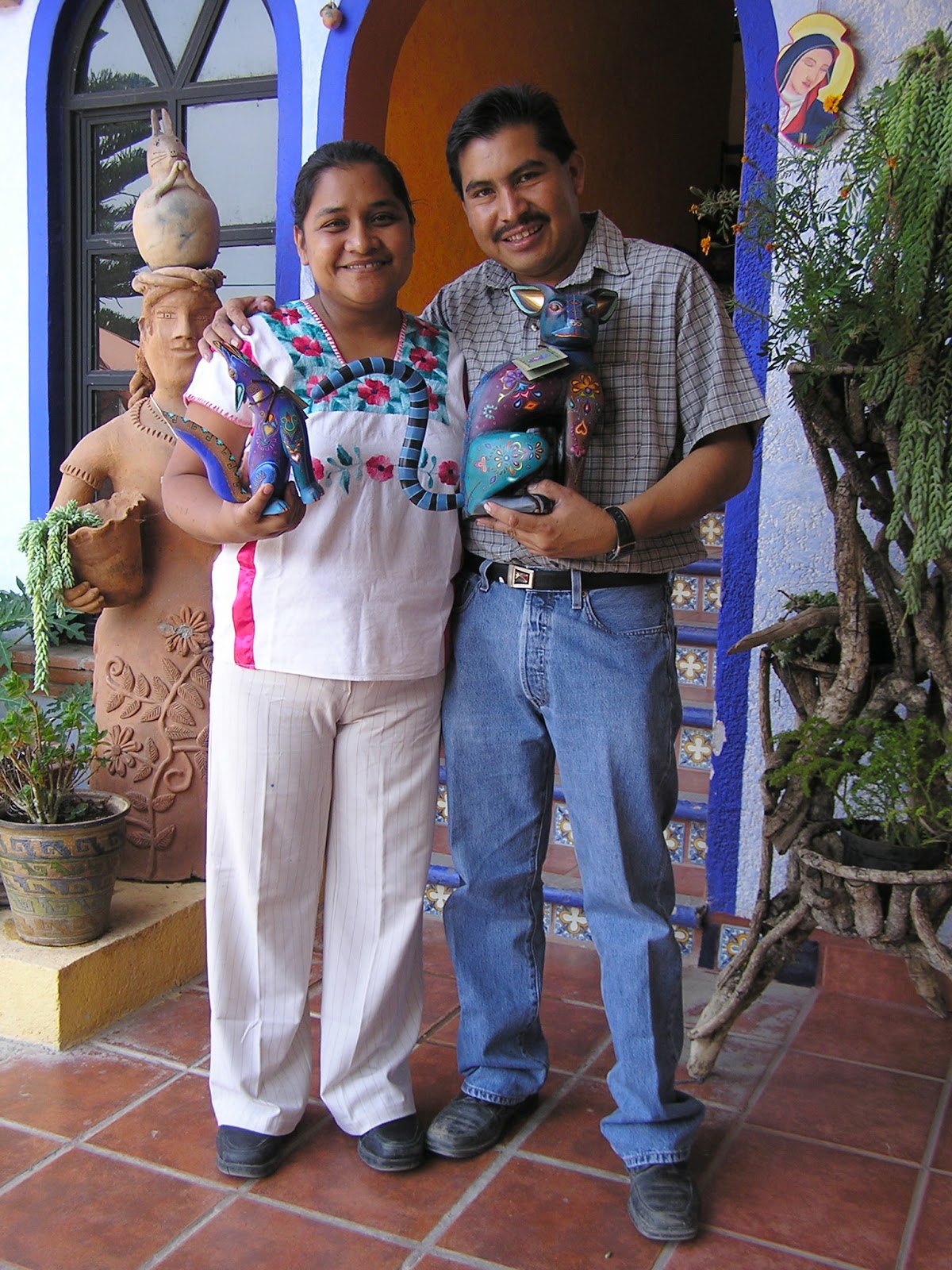

Jacobo and Maria Angeles

In the hands of Jacobo and Maria (and their small group of artists), alebrijes are not just carved and painted wooden animals. They are not just common craft objects, or figures slavishly copied from nature. The figures live in a spirit world, at once whimsical and real. They seem to have their own hidden thoughts. They have a timeless quality, at once ancient and stunningly modern. They are elegant and mysterious, and they draw you in. 
Dog alebrije

Skilled hands carve the figures from copal wood. The figures are then carefully dried, and painted with colors made from natural local materials. The artists use fine-tipped brushes to execute minutely detailed, traditional Zapotec patterns. Everything is done with painstaking care and patience, under the exacting eyes of Jacobo and Maria. A single piece takes months to create (one specially-commissioned 4-ft. coyote took over two years!). These works of art come in a variety of sizes, and are sought by knowledgeable collectors throughout the world. 

Carver at Work

During our recent visit, María Angeles told us that they can easily sell every piece they make, and that they are having trouble keeping up with a worldwide demand. We were nevertheless able to obtain some brilliant pieces for Chiripa, because we have known Jacobo and Maria for years. Come to Chiripa and see these collectors’ items for yourself!       - JM

Painter with Skunk Alebrije


Tuesday, November 13, 2012

Lizards and Bears!


August, 2012.  We are in the state of Oaxaca, in southern Mexico, looking for brilliant artisan crafts for Chiripa.

At Chiripa, you can spot beautifully carved and painted wooden lizards climbing the walls.  The lizards (and other whimsical alebrijes) are created by the husband-and-wife team of Oscar Carillo and Josefina Morales.  The couple work from their home in the village of Arrazola.  From the village, you can look up to see the heights of Monte Alban – the spectacular Zapotec ruins whose construction began around 500 BC.

Oscar is 43 years old and was born in Arrazola.  Josefina is from the state of Tabasco to the east, along the Gulf of Campeche.  The couple met when she was a passenger in the taxi that he was driving in the city of Oaxaca.  They have been married for about 22 years, and have 2 children.  They started producing and selling alebrijes shortly after they were married, to help support their family.  Business was slow at first, but grew over time as their work became known.


As a child, Oscar was more interested in soccer (futbol) than woodcarving.  He learned the wood-carving craft later, from his cousins, and found that he had a talent for it.  But it was Josefina who completed the artistic team.  Oscar creates graceful wooden figures, ready for life, and Josefina adds the living spark with her paint brushes.  “Neither of us could do it alone,” Oscar tells us in Spanish.  “Josefina is a very skilled painter, and she works hard at everything she does.”

For many years, only Oscar signed the completed pieces (the traditional practice for husband-and-wife teams in Mexico).  But at Chiripa’s suggestion, Josefina now signs them as well.  Josefina beams as she proudly adds her signature to each completed work.  Oscar beams too.


Josefina proudly signs a completed bear.

Oscar gets his ideas from the wood he carves.  He examines each piece of wood to visualize the animal spirit it holds.  Then he follows his instincts to bring that spirit out.  Each piece is unique. 

The wood comes from the branches of the copal tree.   Some wood can be found near Arrazola, but much of Oscar’s supply comes from the mountains near the rug-weaving village of Teotitlan del Valle, about 15 miles away.  Harvesters never take the whole tree, just the limbs.  That way, the tree can continue to generate new wood.  A tree must be at least 12 years old before harvesting can begin.

About 10 years ago, Oscar planted some copal trees on his own land.  The trees will be ready to harvest in another couple of years.  Oscar says that the first alebrije he carves from his own wood will be a very special piece, and he will not sell it (even to his Chiripa friends). - JM


Saturday, June 25, 2011

Signed by Josephina, Too!

Musings from the February 2011 Chiripa buying trip to Mexico.
Lizards have become a symbol of Chiripa. The colorful carved creatures have brightened our walls since we opened in 2006 and we have often used them in advertising to help identify the business. They are a popular item at Chiripa and now climb the walls of dozens of homes in Madison and beyond. 
Oscar prepares our selection for shipping.
 
Most of our lizards have had the artist's signature: Oscar Carillo, Arrazola, Oaxaca, Mexico. But Oscar is just half of the story. Oscar carves the playful creatures from copal, a soft wood abundant in that area. His wife, Josephina Morales adds the colorful painted designs. It is often the bright colors and exact details that draw a person to one lizard over another.
Josephina poses with a favorite.

A while ago a customer commented on the signature and asked if perhaps we couldn't encourage the family business to add Josephina's name to the art. I did just that in February when we visited Oscar and Josephina's workshop.
I wish I had had my camera out to capture the big grin on Josephina's face. She quickly picked up a fine pen and added her name to the pieces we selected. 


I hope that she continues to take credit for the fine work that she does. -kl

The doorway to the gallery and workshop in Arrazola.
 
From the streets of Arrazola one can see the ruins of Monte Alban in the distance.

I was taken by the colorful chickens this year. Stop in to see them!

Monday, July 5, 2010

Fine Food and Fantastic Crafts


From the log kept by JM on the Feb/March 2010 Chiripa buying trip.

March 2, 2010.  This morning we traveled south to the villages of San Bartolo Coyotepec, San Martin Tilcajete, and Ocotlan. We picked up a good selection of Oaxacan black pottery at the Dona Rosa workshop in San Bartolo, where Dona Rosa's son still presides. 


Dona Rosa was, of course, the woman who discovered the technique for making the famous shiny black pottery (you can find it at Chiripa) and a piece or two online.


In Ocotlan, we stopped at the tiny home workshop of the famous Guillermina Aguilar, where we picked out as many clay figures as we could carry. 

But the main event was in San Martin Tilcajete, where we met Jacobo and Maria Angeles for breakfast at their restaurant, Azucena Zapoteca (Zapotec Lily). The day was already hot, but there was a cool breeze under the veranda. Jacobo and Maria offered us a spectacular array of traditional Zapotec and Mexican dishes. The food was fabulous, and the presentation reflected Maria's artistic touch (Rick Bayless take note!).


 The restaurant, magical as it was, was just a prelude to the workshop. Jacobo and Maria are among the most highly regarded artisans in all of Mexico producing exquisitely carved and painted alebrijes that are in great demand by collectors throughout the world.

Jacobo and Maria with a lion in progress March 2010.

The carved wooden animals have an uncanny lifelike but abstract quality, and the painting--well, you must see it to believe it: elegant designs are executed in unbelievably minute and precise detail, using traditional Zapotec motifs and stunning natural colors. The colors are from natural ingredients grown in the Oaxacan countryside. You can see some beautiful examples at Chiripa. 


We also hope to bring Jacobo to Madison in October, so you can meet this great artist (and wonderful human being) in person.


Friday, March 12, 2010

Home Again

Those following this blog will have noted that I did not post anything while on the Chiripa buying trip to Mexico. We set an almost impossible schedule with little time to find and use a computer.

Future posts will lead you through some of the highlights of the trip. But, because it is still tourist season in southern Mexico I wanted to promote a favorite artist and a favorite restaurant.

Maria and Jacobo with their new Chiripa caps!

Jacobo and Maria Angeles of San Martin Tilcajete, Oaxaca, Mexico create stunning alebrijes and run one of the finest workshops in Oaxaca. And we will write more about it in a future post. But, who would have guessed that their restaurant (at the junction of the main highway and the road that leads into San Martin) offers some of the finest food we've tasted in Mexico.

Azucena Zapoteca
Cocina Tradicional Oaxaquena
Carretera Pro. Angel Km. 23.5
San Martin Tilcajete
Ocotlan, Oaxaca
Tel. 52 49 227 / 52 49 228
email: angeles@tilcajete.org

DON'T PASS BY. STOP, EAT, ENJOY.

This was one dish that included a delicious mole and that amazing stringy Oaxacan cheese. What a treat!

Next to the restaurant you'll find a gift shop with a wonderful sampling of Mexican artisan crafts. You may also get to watch some of the master painters working on their alebrijes.

And in the near future you'll be able to see some of their fine pieces at CHIRIPA.


Tuesday, October 20, 2009

Chicago Visit

We interrupt the Chiripa buying trip log to tell you about a fantastic opportunity in Chicago. The National Museum of Mexican Art is hosting a Folk Art Festival from now until Sunday, October 25.

We took the opportunity to drive down and visit two of our close Oaxaca friends who are part of this special exhibit and sale. Jacobo Angeles (carved and intricately painted wooden figures-alebrijes) and Bulmaro Perez (hand woven and naturally died wool rugs) have brought dozens of samples of their expert craftmanship.

Jacobo is always laughing;
he's holding on to the loom that Bulmaro shipped to the museum to demonstrate his craft.


If you have the opportunity to visit Chicago and the museum you won't find a better place to see their work in the Midwest (except at Chiripa, of course!) and to meet with the artist and learn about the natural die processes that they use. Please tell Jacobo and Bulmaro that we sent you!
When the museum closed we took Jacobo and Bulmaro to dinner. They chose the cuisine (Mexican, of course) and we headed for Frontera Grill, the Rick Bayless restaurant on Clark St. in downtown Chicago.

Jacobo and Bulmaro at Frontera Grill, Chicago.

From the mezcal apartif and through the meal we caught up on each other's businesses and learned about their family traditions for the coming Day of the Dead (Dia de los Muertos) celebrations.
By chance, Rick was at the restaurant that night and Jacobo and Bulmaro were fortunate enought to meet him and invite him to their homes when he travels to Mexico. It was a very special night!

All camera's came out for the photo op with Rick Bayless.
Jacobo is holding some of his work.


I can't say enough good things about the National Museum of Mexican Art. This is the very best time to see it if you are interested in Dia de los Muertos. A large exhibit space is dedicated to altars (ofrendas) that honor individuals or groups of people who have passed beyond this world.

Other exhibitors at the Folk Art Festival: Guillermina Aguilar from Ocotlan, Oaxaca (clay figures); Miriam Castaneda from Xoxocotla, Morelos (paper Mache); Florentina Lopez de Jesus from Xochistlahuaca, Guerrero (back strap loom weaving); Jose Jorge Garcia from Oaxaca, Oaxaca (silver filigree jewelry) and the Mondragon Family from Toluca, Estado de Mexico (sugar skulls).

The Mondragon family comes to the museum a month before Dia de los Muertos to make 20,000 sugar skulls. They will write a name on the skull if you wish. The museum sells out.

The photogenic Gillermina Aguilar graciously consented to a photo.
Her family's work can be found at Chiripa.


It looks like a cold and rainy weekend ahead. Our Mexican friends are shivering. Go say hello from us and spread some warmth!

Tuesday, October 13, 2009

Arrazola


A post from the log that JM kept on the August 09 buying trip to Mexico for
Chiripa. -kl


"Today we were on another old bus as it lurched out of Oaxaca’s noisy Abastos Market, headed for the village of Arrazola. Gears ground as the bus pounded its way over endless potholes and speed control bumps (“topes”), and stopped frequently to gain and lose passengers. The day already promised heat, and the bus was dark with dust and exhaust fumes. The short trip seemed endless, but at last we reached the village. On the distant heights above the town, we could see pyramids forming part of the spectacular pre-Columbian ruins of Monte Alban.

"Arrazola, like San Martín, is known for its painted wood carvings. But our initial impressions were not favorable. As we worked our way up the steep cobbled streets, ducking into family workshops, we found mainly mediocre work.


"But at last we stumbled into the workshop of Sergio Santiago. This was something different!


"The delightful figures seemed to come alive, and we had fun picking out a good selection for our Chiripa customers. If the figures survive the trip to Wisconsin (Ojalá!), you will soon see them at the shop. -JM Aug 8,2009

Tuesday, October 6, 2009

Ocotlan, San Martin Tilcajete, And More

A post from the log that JM kept on the August 09 buying trip to Mexico for Chiripa. -kl

"This morning we jumped off the bus and plunged into the busy Friday market in the village of Ocotlán. The market is teeming with country folk buying and selling aromatic peppers, fruits and vegetables, fresh cheese, live turkeys with feet tied together, hardware, clothing and other goods. You can still see lots of older women in traditional pleated skirts, embroidered blouses, aprons, headdresses and rebozos, and men in handmade straw sombreros. But when their generation is gone, you will probably see only machine-made baseball caps, T-shirts and jeans from China and Indonesia.


"On our way out of Ocotlán, we bought clay figurines at the cluttered multi-family households of the famous Aguilar sisters. Then we hopped on the bus, and headed down the road to the villages of Santo Tomás Jalietza (weaving on backstrap looms) and San Martín Tilcajete. We nearly lost Kathy when the bus started before she was fully on board, but she managed to stay upright and hang on. One passenger carried a handsome live chicken, in an open plastic bag, from the market in Ocotlán. The bus dropped us along the highway, so we hiked into town.


"San Martín is famous for colorfully-painted carved wooden figures called alebrijes, and in the village plaza many of the artisans had their works on display. We picked out a good selection, then walked down the rocky dirt street to our primary destination at the far end of the village – the home of Jacobo and Maria Angeles. These world class artisans produce exquisitely carved and painted alebrijes that raise the craft to the level of high art. You can see several fine examples of their work at Chiripa.


"We ended the day at the village of San Bartolo Coyotepec, home of the famous Oaxacan black pottery. Examples of the pottery are available at Chiripa." -JM Aug 7,2009

Monday, August 10, 2009

Day 5: Shopping for Alebrijes


Saturday, August 8: The Chiripa 2009 Summer Buying Trip to Mexico

Arrazola, Oaxaca, Mexico is today's destination. The shoppers are in search of mid-price alebrijes, the colorful painted figures that are carved of wood.

The lizards at Chiripa come from the Arrazola workshop of Oscar Carillo and his wife Josefina. Oscar is the carver and Josefina the painter.


The lizards have become a trademark for our shop and adorn the walls and shelving ends. I've heard from Beth that the expedition was a success. I'll have to wait for the shipment to see the beautiful creatures.

Saturday night's activity is packing. This will be a marathon event. Every item that has been purchased to date will get two labels: "Made in Mexico" and "wood (or whatever it is)." Each piece will be carefully wrapped and packed in a box. (At some point boxes and bubblewrap and packing tape will have been procured.) Then each box will get a packing list detailing the contents, the source, and the material along with an address label for Madison, Wisconsin. These boxes will be picked up by Bulmaro who will see that they get sent to our shipper in Guadalajra along with the rugs we purchased from him.

Now that's a Saturday night!

Wednesday, December 3, 2008

Alebrijes and More

Today it is snowing in Madison, Wisconsin. The continuing journal of the last buying trip to Mexico makes me homesick for the warmth and color and fine friends of Mexico. Sigh. . .

[Continuing journal written by
Chiripa partners on a recent buying trip.]

August 23

Jacobo Angeles and his wife María produce the finest alebrijes in Mexico. They are also wonderful people, and it was a pleasure to visit them again this year. We found them in their family workshop in the village of San Martín Tilcahete, Oaxaca, Mexico.


Many artisans in the Oaxaca area produce alebrijes -- carved and painted wooden animals that can take many forms. But Jacobo and Maria have raised this craft to the level of fine art. Their finely carved pieces are typically produced from a single piece of wood, and have an amazingly graceful and living form. The figures are painted with intricate, precise and complex designs (using beautiful naturally-derived colors and traditional indigenous patterns) that you must see to believe. The completed figures have a pensive, elegant, almost human quality. We bought a number of fine pieces from Jacobo and María, including a big, exquisitely painted Jaguar head.

Maria with the jaguar head that she so expertly painted.

In a place of honor at Chiripa.

The road to San Martín Tilcahete goes through other craft villages including San Bartolo Coyotopec, Santo Tomás Jalieza, and Ocotlán. In San Bartolo we visited the workshop of the late Rosa Real Mateo (Doña Rosa discovered the process for producing the famous Oaxacan black pottery), and picked out a number of black pottery pieces for Chiripa.

Click on the photo to see a piece of black pottery for sale on the Chiripa website.

In Santo Tomás we chose some fine and colorful cotton table linens woven on traditional backstrap looms by women in the town.


In Ocotlán, we visited the family workshop (commune, really) of the famous Josephina Aguilar and her extended family. Chickens and turkeys strutted through the compound, and a host of grandchildren ran about and posed for photos as we selected some of the small clay figurines for which Josephina is famous.


Between villages, we got on and off several local buses. In San Martín, we also got a ride in the little golf-cart type vehicle that serves as the village taxi. Finally, as evening approached, we climbed on the bus and headed back to Oaxaca. On our way back to the hotel, we stopped in at the Majordomo Chocolate store in the bustling market district southwest of the zócalo, where they make fresh chocolate to order, and had our traditional hot chocolate.