Monday, December 17, 2012

Night Bus to Chiapas

August, 2012.  We continued our journey through southern Mexico, seeking out fine artisan crafts for Chiripa.

From the City of Oaxaca, we took the regular overnight bus to San Cristóbol de Las Casas, in the green highlands of Chiapas. Chiapas is located in the far south of Mexico, next to Guatemala. It is the ancestral homeland of the Mayan people. Our overnight bus trip from Oaxaca to San Cristóbol took more than 11 hours. The route climbed over rugged mountains, descended into hot lowlands in the Isthmus of Tehuántepec, and then climbed again into misty Chiapas. We didn’t get much sleep during the ride, but in Chiapas we met some wonderful people and found some great crafts for Chiripa!


Chiapas Woman with her Folk Art, 
Traditional Blouse and Heavy
Black Woolen Skirt

We started our journey at nightfall, in a pouring rain, and soon left the City of Oaxaca behind us. The bus wound its way up the steep mountain road in complete darkness. Rock walls, brush, guard rails and black empty space swept to and fro across the headlights as the driver negotiated endless switchbacks – now shifting into low gear, now pumping the brakes.  

Occasionally, a heavily loaded truck emerged from the darkness above and roared past us on the narrow road. Other times, we passed sluggish trucks that were grinding up the mountain ahead of us. The windshield wipers kept up a quiet rhythm, and the bus driver played low salsa music to keep himself awake. 


Morning in San Cristóbol, Chiapas

We dozed fitfully in the dark bus, trying in vain to find restful sleeping positions. In the seats ahead and behind, fellow passengers snored (and maybe we did too – at least in our intermittent moments of sleep). As the bus pushed on through the hot Isthmus of Tehuántepec, we passed humble outdoor cafes (comedors) where clusters of people sat eating and conversing in the cool midnight hours. The dimly lighted scenes came and went, as if in a dream. Then our heads dropped and our eyes closed again.


Lunch on the Street, San Cristóbol

Dawn was breaking when we pulled into San Cristóbol. The mountain air was cool and fresh as we stepped down from the bus. Our backs were stiff and our knees were cramped, but a good cup of hot black Chiapas coffee would soon put us in shape for the craft hunt.        - JM

Woman with Braids, San Cristóbol

Sunday, December 9, 2012

True Collectors' Items

August, 2012. We are traveling in the state of Oaxaca, in southern Mexico, in search of fine artisan crafts for Chiripa.

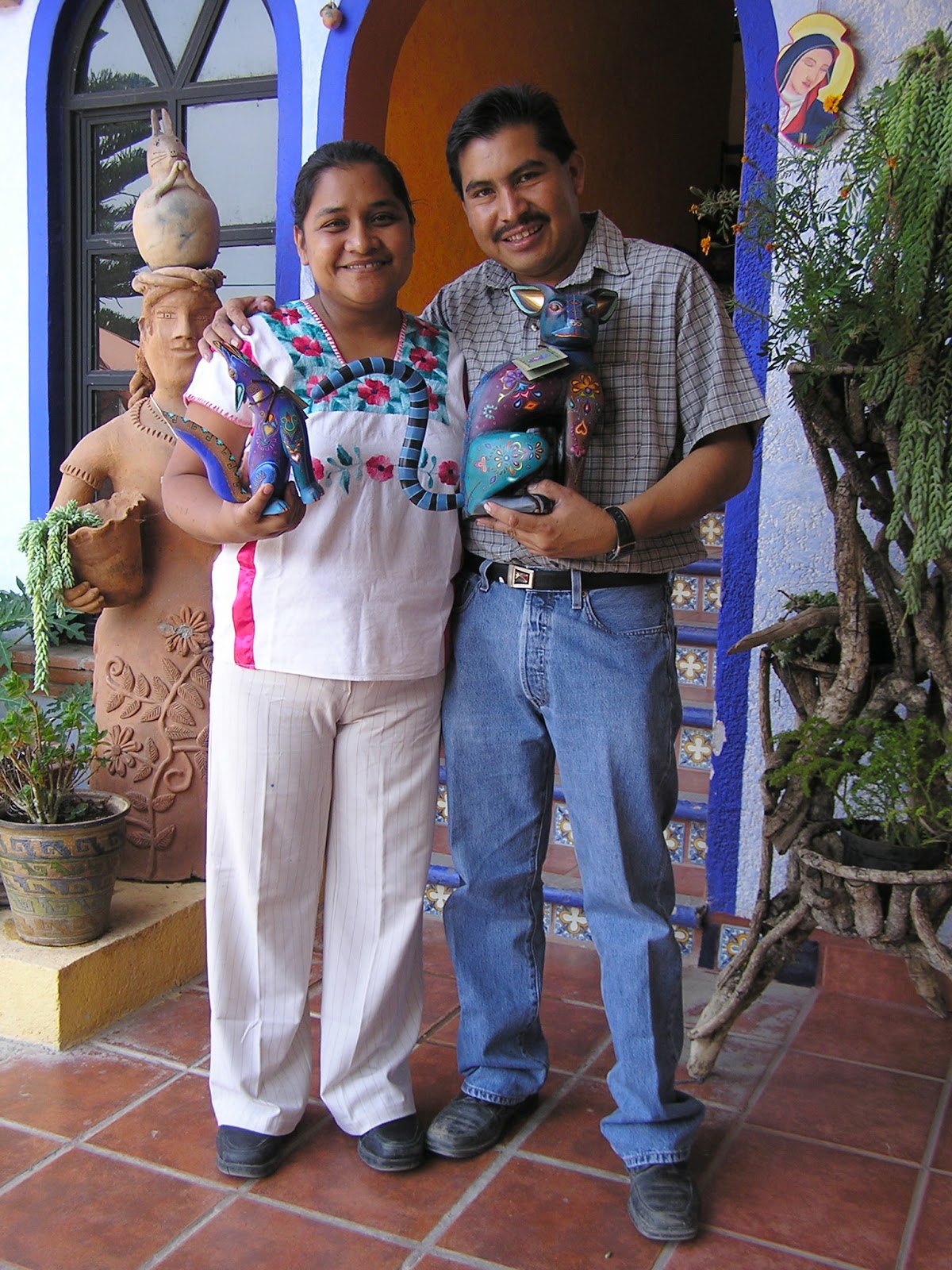
In the world of Mexican indigenous crafts, Jacobo and María Angeles are rock stars. In their colorful workshop, on a dirt-and-cobble lane in the far corner of the small Zapotec village of San Martín Tilcajete, they carve and paint the most beautiful alebrijes on the planet. Jacobo and María were born in the village, and have known each other since they were children. Jacobo learned wood carving from his father, who died when Jacobo was just 12 years old.


Jacobo and Maria Angeles

In the hands of Jacobo and Maria (and their small group of artists), alebrijes are not just carved and painted wooden animals. They are not just common craft objects, or figures slavishly copied from nature. The figures live in a spirit world, at once whimsical and real. They seem to have their own hidden thoughts. They have a timeless quality, at once ancient and stunningly modern. They are elegant and mysterious, and they draw you in. 
Dog alebrije

Skilled hands carve the figures from copal wood. The figures are then carefully dried, and painted with colors made from natural local materials. The artists use fine-tipped brushes to execute minutely detailed, traditional Zapotec patterns. Everything is done with painstaking care and patience, under the exacting eyes of Jacobo and Maria. A single piece takes months to create (one specially-commissioned 4-ft. coyote took over two years!). These works of art come in a variety of sizes, and are sought by knowledgeable collectors throughout the world. 

Carver at Work

During our recent visit, María Angeles told us that they can easily sell every piece they make, and that they are having trouble keeping up with a worldwide demand. We were nevertheless able to obtain some brilliant pieces for Chiripa, because we have known Jacobo and Maria for years. Come to Chiripa and see these collectors’ items for yourself!       - JM

Painter with Skunk Alebrije


Monday, November 26, 2012

Breakfast With a Master Weaver

August. 2012.  We are traveling in the state of Oaxaca, in southern Mexico, seeking out fine artisan crafts for Chiripa.

Bulmaro Perez is one of the finest rug weavers in Mexico. He was born and lives in the Zapotec village of Teotitlán del Valle, in the Central Valley of Oaxaca. This is Mexico’s weaving epicenter, and Bulmaro is among the “best of the best.”  Bulmaro is regularly invited to display his work in U.S. museums and galleries. Bulmaro learned the craft from his father, a nationally recognized maestro, and has taken his father’s craft to a new level. 

Bulmaro and His Father

Bulmaro is steeped in the Zapotec weaving tradition, but often puts a new twist on traditional Zapotec designs. His rugs are made of pure wool, and he uses dyes made from natural local materials like cochineal, witch hazel, indigo, marigolds and pomegranate shells.  Cochineal, used to make the color red, is made from an insect that grows on nopal cactus. In colonial times, it was one of Mexico's most important export products (next to gold and silver) because it was so highly valued in Europe. We have watched Bulmaro dye the wool that he uses.

Natural Dye Materials

Bulmaro is a family man and community leader. Like every other adult male in Teotitlán, he devotes a substantial amount of time each year to village administration and service. He is also a very gentle and hospitable man. His home is filled with flowers, including some unusual varieties that he has collected. 

Bulmaro speaks to his wife in soft Zapotec tones. He pads around on bare feet as he shows his woven creations. His eyes dance with delight at the beauty around him. He smiles easily, nods and tilts his head in courtesy. 

Before showing us his rugs, Bulmaro insisted on buying us breakfast at his favorite taco restaurant. The restaurant specializes in tacos made from beef cheeks. We had to quit after three tacos. He ate five, and with gusto, because he didn’t know when he would get lunch. After breakfast we went to Bulmaro’s house, where we selected some beautiful rugs (including lovely Tree of Life and Zapotec Patio patterns). See them for yourself at Chiripa! - JM


Tree of Life


Tuesday, November 13, 2012

Lizards and Bears!


August, 2012.  We are in the state of Oaxaca, in southern Mexico, looking for brilliant artisan crafts for Chiripa.

At Chiripa, you can spot beautifully carved and painted wooden lizards climbing the walls.  The lizards (and other whimsical alebrijes) are created by the husband-and-wife team of Oscar Carillo and Josefina Morales.  The couple work from their home in the village of Arrazola.  From the village, you can look up to see the heights of Monte Alban – the spectacular Zapotec ruins whose construction began around 500 BC.

Oscar is 43 years old and was born in Arrazola.  Josefina is from the state of Tabasco to the east, along the Gulf of Campeche.  The couple met when she was a passenger in the taxi that he was driving in the city of Oaxaca.  They have been married for about 22 years, and have 2 children.  They started producing and selling alebrijes shortly after they were married, to help support their family.  Business was slow at first, but grew over time as their work became known.


As a child, Oscar was more interested in soccer (futbol) than woodcarving.  He learned the wood-carving craft later, from his cousins, and found that he had a talent for it.  But it was Josefina who completed the artistic team.  Oscar creates graceful wooden figures, ready for life, and Josefina adds the living spark with her paint brushes.  “Neither of us could do it alone,” Oscar tells us in Spanish.  “Josefina is a very skilled painter, and she works hard at everything she does.”

For many years, only Oscar signed the completed pieces (the traditional practice for husband-and-wife teams in Mexico).  But at Chiripa’s suggestion, Josefina now signs them as well.  Josefina beams as she proudly adds her signature to each completed work.  Oscar beams too.


Josefina proudly signs a completed bear.

Oscar gets his ideas from the wood he carves.  He examines each piece of wood to visualize the animal spirit it holds.  Then he follows his instincts to bring that spirit out.  Each piece is unique. 

The wood comes from the branches of the copal tree.   Some wood can be found near Arrazola, but much of Oscar’s supply comes from the mountains near the rug-weaving village of Teotitlan del Valle, about 15 miles away.  Harvesters never take the whole tree, just the limbs.  That way, the tree can continue to generate new wood.  A tree must be at least 12 years old before harvesting can begin.

About 10 years ago, Oscar planted some copal trees on his own land.  The trees will be ready to harvest in another couple of years.  Oscar says that the first alebrije he carves from his own wood will be a very special piece, and he will not sell it (even to his Chiripa friends). - JM


Thursday, October 25, 2012

A Black Pottery Storm


August, 2012 - We are traveling in the state of Oaxaca, in southern Mexico, looking for unique artisan crafts for Chiripa.  August is the rainy season in this mountainous area.

It is late afternoon when the old bus drops us at the village of San Bartolo de Coyotepec.  From the main road we walk to the Doña Rosa pottery workshop.  Doña Rosa, a Zapotec woman, created a special black pottery process for which Oaxaca is world famous.  Although Doña Rosa is long deceased, her pottery tradition lives on.

Dark clouds threaten as we enter the workshop, and thunder rolls through the valley.  The first raindrops splatter tentatively in the dust.  Then the sky gives way, and the rain pounds the earth. 


Rain Falls at the Pottery Workshop

We wander in comfort under the tile roof, sidestepping leaks and listening to the hypnotic splash of water in the courtyard.  We have the place to ourselves, and with the storm raging we are in no hurry to leave.  We take time to select our favorite pieces for Chiripa.  The prices are reasonable, as you will see.  We arrange for packing and shipping, then wait for the rain to relent.  When the storm lets up a bit, we make a run for the bus stop.

We try to jump the muddy stream that is now rolling down the street, but we fall short and go in over our shoes.  A bicyclist pedals downstream, leaving a wake behind him.  By the time we reach the main road we are drenched.  Fortunately, a bus from the villages to the south is just pulling up.  We wave it down, and straggle aboard.  We ask the fare, but the driver just waves us in.  We can pay later, he says.


Pedaling Downstream

Friendly passengers in well-worn clothing nod a greeting as we bump down the aisle.  The driver grinds through the gears, and the bus roars toward the city of Oaxaca.  A crucifix swings from the rearview mirror. - JM

Thursday, October 11, 2012

My Wallet is Gone!

August 2012.  We are in southern Mexico, collecting beautiful artisan crafts for Chiripa.

... And then it happens.  Every traveler’s nightmare moment.  You reach into your pocket or purse, and your wallet is missing!  My moment came as we were packing Oaxacan crafts for shipment to Chiripa.  The hotel room was filled with ceramics, textiles, alebrijes and tin, as well as cardboard boxes, newpaper, bubble wrap, marking pens and packing tape.  The hotel checkout deadline was in half an hour.

I had made repeated trips to buy more boxes and packing supplies, and from the last of those trips my wallet had not returned.  I feared and imagined the worst.  But when I asked at the little paper supply store (the one with the portable stairway that is put out on the sidewalk each morning, and taken in at night), the young woman opened a wooden drawer and pulled out a well-worn wallet.  “Is this it?” she smiled.  It was.  Everything was there.  I offered her a reward, but she declined.  “It is a pleasure to help,” she smiled. -JM


Thursday, September 13, 2012

Mountains and Rain


August, 2012.  We are traveling in southern Mexico, looking for distinctive artisan crafts for Chiripa.

It is the rainy season in Oaxaca.  In the morning, strands of misty clouds hang from the lovely shoulders of the green mountains, like elegant necklaces.  


Brilliant flowers glitter in the soft air.  


After an afternoon shower, a ray of sunlight breaks through.  It drapes the weathered old cathedral in glory, and crowns it with a rainbow.


In the village of Teotitlan del Valle, weavers listen to the rain and peek out from under dripping tile roofs.  Then they lean into their work once again, crafting elegant wool rugs on wooden pedal looms.  The rugs (tapetes) emerge in glorious patterns and colors from nature.  The variety is endless, put a popular pattern is “Mountains and Rain.” 


 At Chiripa, you can see tapetes from some of the best weavers in Mexico. -JM